 Apple Computer Memorabilia Company: Apple Computer Inc. Based: Cupertino, CA. Founded: 1976 Founders: Steve Wozniak, Ronald Wayne & Steve Jobs Specialty: Developing Personal Computers, Smartphones, Tablets, Business servers, wearable devices, & other consumer electronics. Now designs their own processors in-house for use in their Mac computers. |
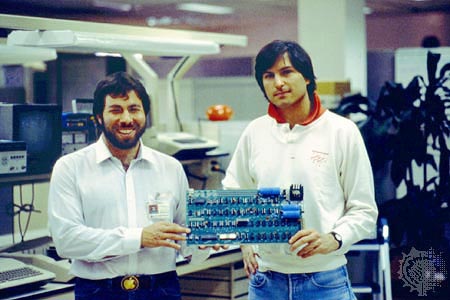 Steve Wozniak & Steve Jobs with an Apple I Motherboard (1976) |
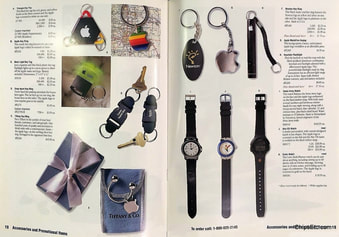
Apple Promotional Keychains, Jewelry, Clothing & gifts
|
Apple Promotional Gift item Catalogs Apple Computer Gift Catalog (1983) Apple Collection Gift Catalog (1986) Apple Merchandise Gift Catalog (1995) |
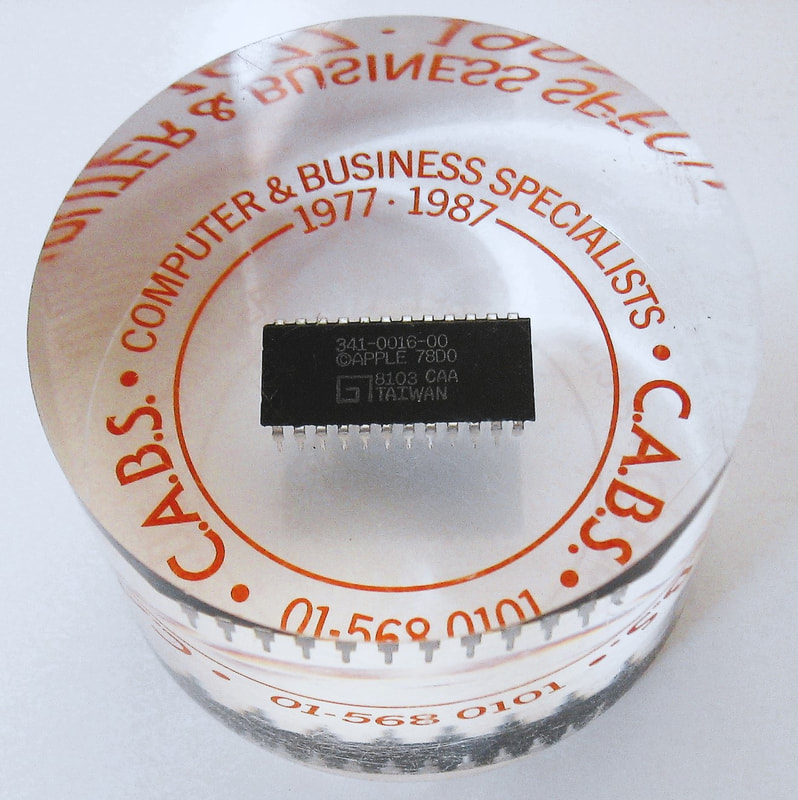
Apple II Computer ROM chip paperweight (1987)
Item #1031
This is Lucite paperweight from the C.A.B.S. computer & business specialist for their 10 year anniversary of being in business.
Embedded inside is a ROM memory chip for an Apple II home computer. It is a 2kB D0 Programmer's Aid, masked 2316, ROM chip used in the Apple II and Apple II+ home computers.
This chip was manufactured for Apple Computer by a semiconductor company called General Instrument.
The ROM chip is marked with Apple part # 341-0016-00, with a date code of March of 1981 and was manufactured in Singapore.
Embedded inside is a ROM memory chip for an Apple II home computer. It is a 2kB D0 Programmer's Aid, masked 2316, ROM chip used in the Apple II and Apple II+ home computers.
This chip was manufactured for Apple Computer by a semiconductor company called General Instrument.
The ROM chip is marked with Apple part # 341-0016-00, with a date code of March of 1981 and was manufactured in Singapore.
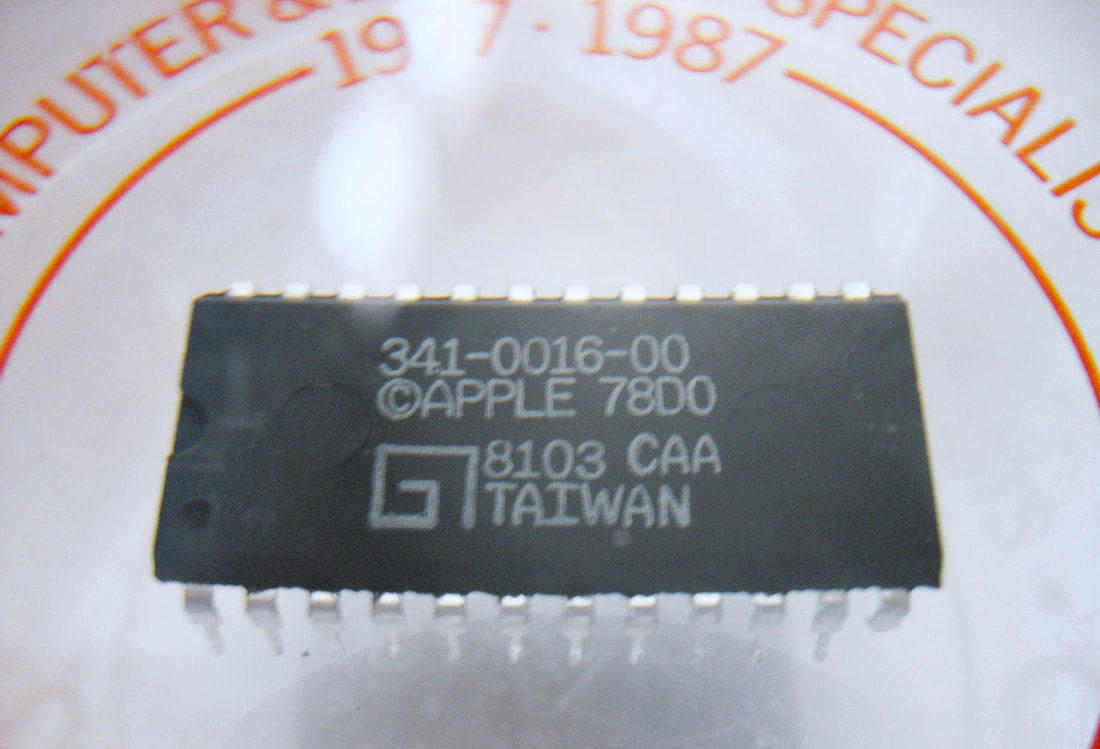
Apple II Computer ROM chip with datecode 1981
Apple Computer Rainbow logo Pendant Necklace (1983)
Sold
This is a Vintage Apple Computer rainbow Pendant chain necklace. During the 1980's Apple jewelery was a popular item for sale in the Apple gift catalogs.
The pendant is gold tone metal with the famous Apple rainbow logo colors in cloisonné enamel. This pendant & 10k gold plated chain (K-001) was featured in the 1983 Apple Computer Gift Catalog as part of the Apple Jewelry collection and was also offered with a 14k gold chain (K-002).
The pendant is marked on the back: Apple Computer Inc. (Apple dropped the word "Computer" from its name on Jan. 9th 2007 to show its expansion and development into consumer electronics.)
Pendant measures 3/4" in diameter and the chain is 16" long from end to end.
The pendant is gold tone metal with the famous Apple rainbow logo colors in cloisonné enamel. This pendant & 10k gold plated chain (K-001) was featured in the 1983 Apple Computer Gift Catalog as part of the Apple Jewelry collection and was also offered with a 14k gold chain (K-002).
The pendant is marked on the back: Apple Computer Inc. (Apple dropped the word "Computer" from its name on Jan. 9th 2007 to show its expansion and development into consumer electronics.)
Pendant measures 3/4" in diameter and the chain is 16" long from end to end.
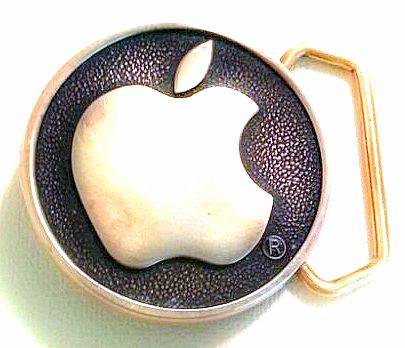
Apple Computer Brass Belt Buckle (1983)
Sold
This is an Apple Computer Logo Belt Buckle that was only offered for sale in the 1983 Apple Gift Catalog.
Co-Founder Steve Wozniak was known to wear this belt buckle around Apple Computer during the mid 1980's.
Solid brass, buckle was made in the USA for Apple Computer by BTS.
Co-Founder Steve Wozniak was known to wear this belt buckle around Apple Computer during the mid 1980's.
Solid brass, buckle was made in the USA for Apple Computer by BTS.
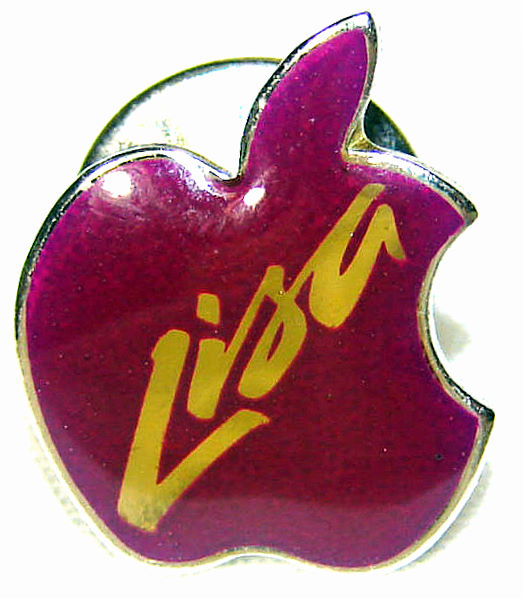
Apple Lisa Computer Pin (1983)
Sold
An Apple Lisa dealers pin to promote the sale of Apple's Lisa computers in 1983.
Metal pin with red and gold enamel.
Measure 1/2" wide x 5/8" tall.
Metal pin with red and gold enamel.
Measure 1/2" wide x 5/8" tall.
Apple Computer Rainbow Logo Sticker (1983)

Sold
This sticker from Apple Computer was very popular in the 1980's.
Features the Apple rainbow logo.
Features the Apple rainbow logo.
Apple Lisa Computer Pin (1983)
Sold
An Apple Lisa dealers pin to promote the sale of Apple's Lisa computers in 1983.
Metal with black enamel background and multicolored Apple rainbow logo.
Measure 1" wide x 3/8" tall.
Metal with black enamel background and multicolored Apple rainbow logo.
Measure 1" wide x 3/8" tall.
Apple Computer Rainbow Logo Pin (1983)
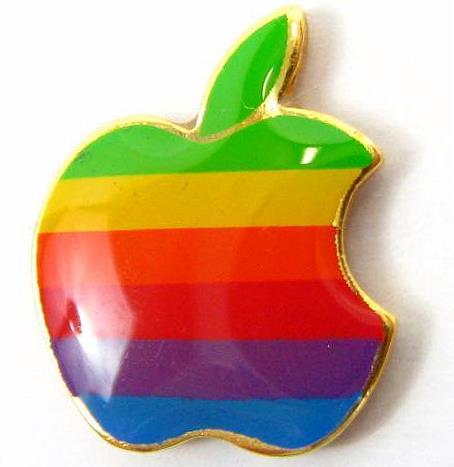
Sold
This colorful Apple rainbow logo pin is metal with enamel.
Apple Computer Rainbow Paperclip Book Marker (1983)
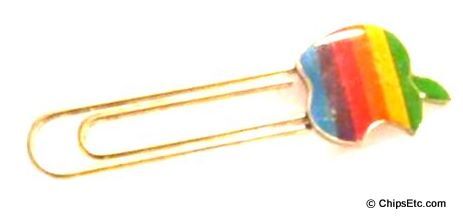
Sold
Large book-marker in the form of a paperclip that has the Apple Rainbow logo on the tip.
Apple Computer Rainbow Logo Embroidered Sticker (1983)
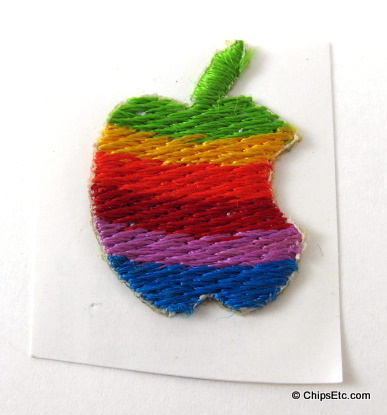
Item #314
This is a Stitched Apple logo with adhesive backing.
Apple Computer Rainbow Logo Embroidered Patch (1983)
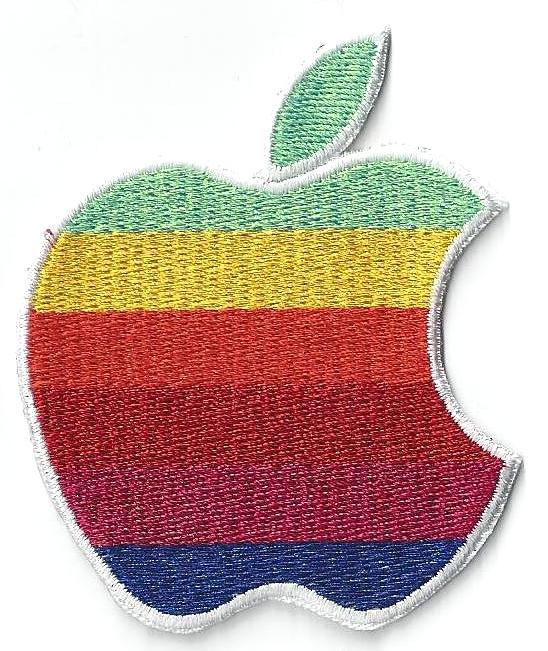 Sold
Sold
Apple embroidered iron on patch features the colorful apple rainbow logo.
Measures 2 1/2 x 3".
Measures 2 1/2 x 3".
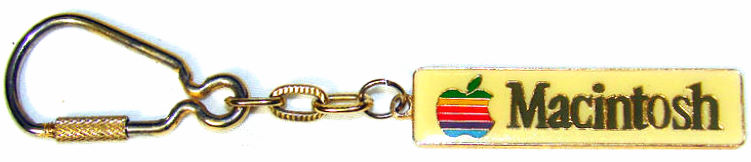
Apple Macintosh Computer Keychain (1984)
Sold
An Apple Macintosh Keychain promoting Apple's new 128k Macintosh computer in 1984.
Metal pin with the Apple rainbow logo on white enamel.
Measure 2" wide x 1/2" tall.
Metal pin with the Apple rainbow logo on white enamel.
Measure 2" wide x 1/2" tall.
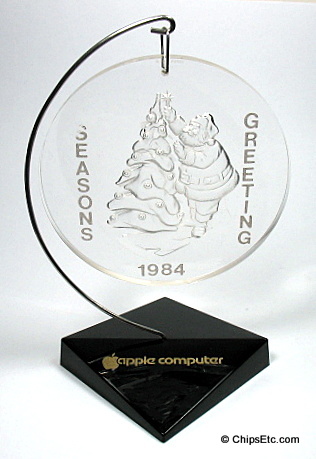
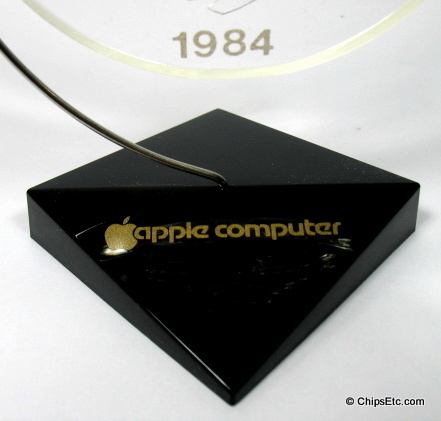
Apple Computer Christmas Ornament (1984)
Item #786
Apple Computer Christmas ornament given to Apple Employees as a gift in 1984.
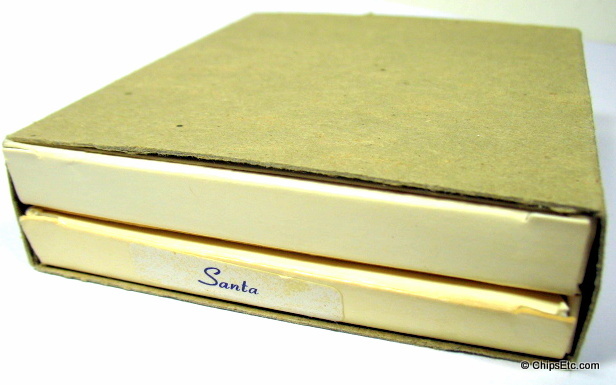
Comes new in original gift box.
Measures 3 1/4" wide and 5 1/2" tall.
Comes new in original gift box.
Measures 3 1/4" wide and 5 1/2" tall.
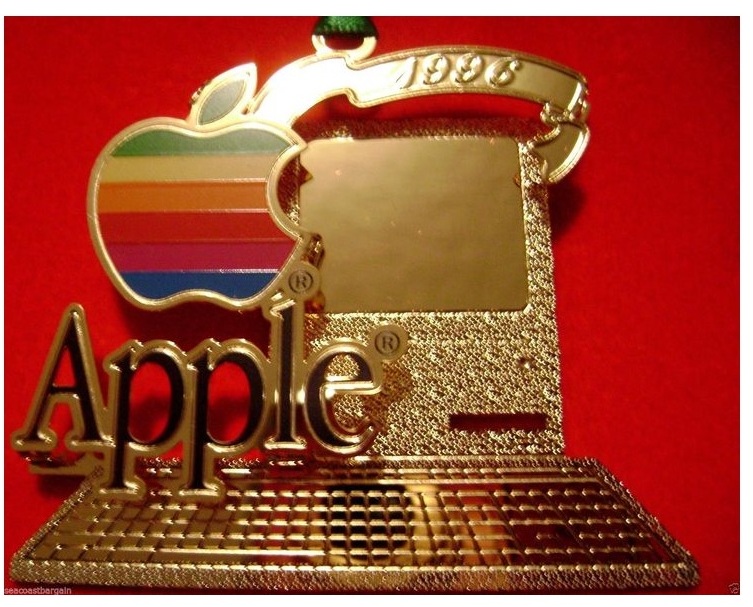
Apple Computer Christmas ornament gift to employees (1996)
|
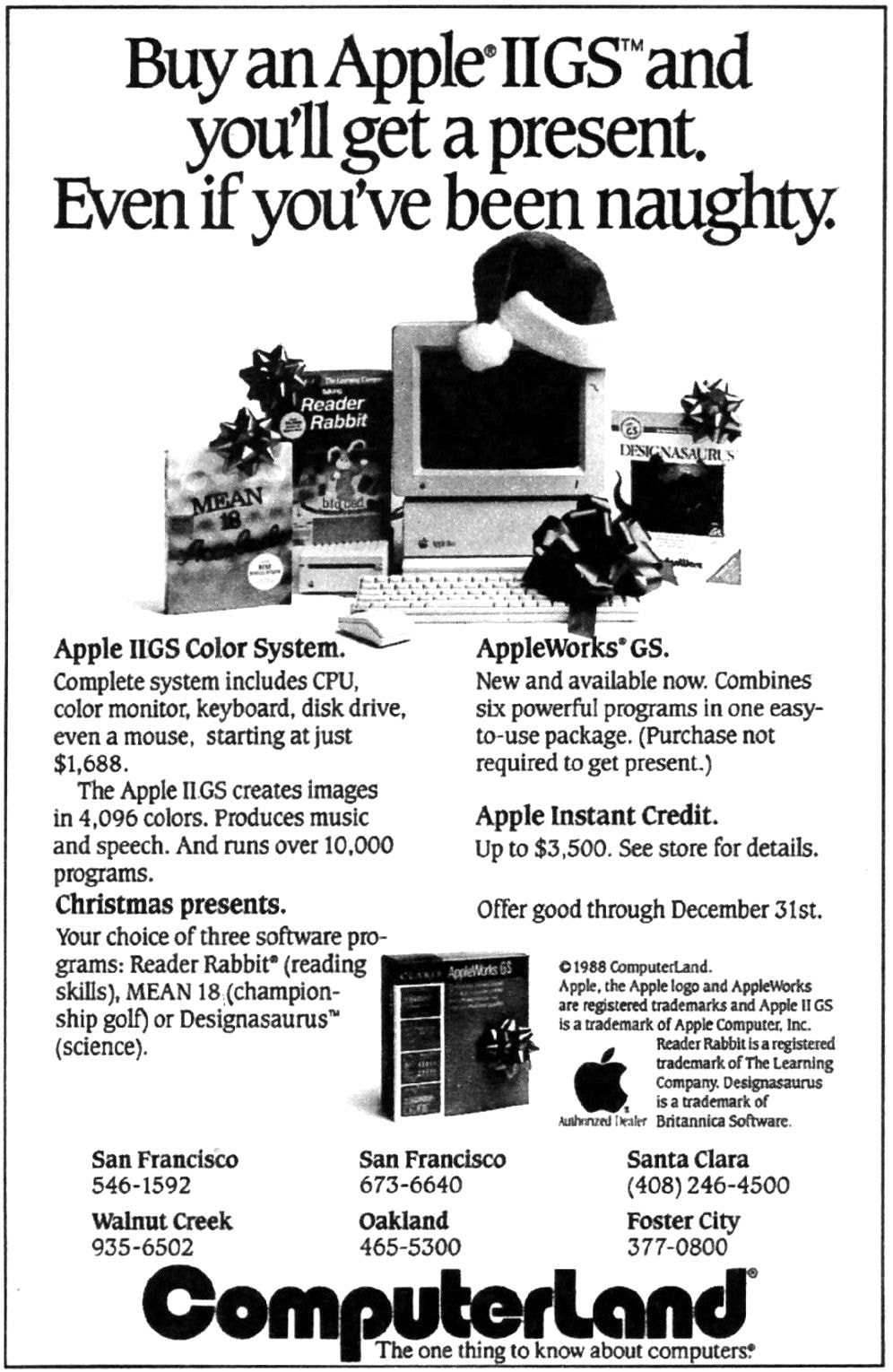
Apple IIGS Computer, Christmas ad from Computerland of California (1988)
|
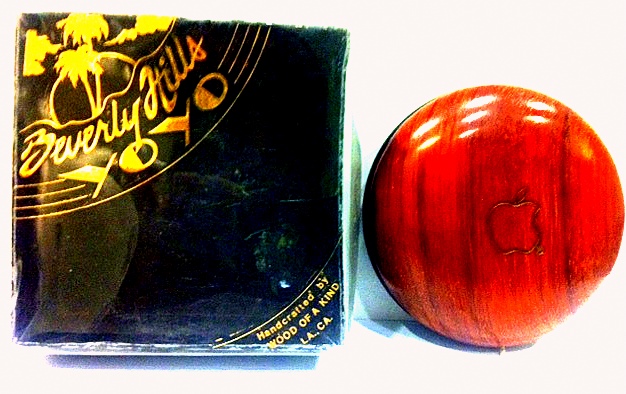
Apple Logo Yo-Yo (1990's)
Sold
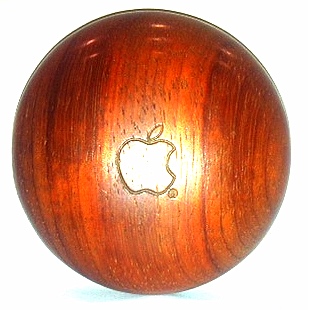
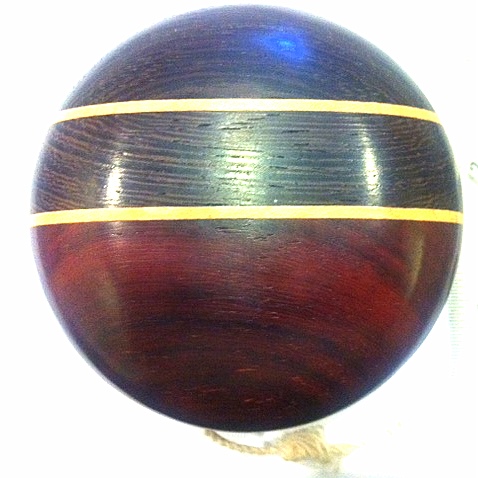
This is a rare wooden Yo-Yo with the Apple logo given to some Apple employees during the early 1990's.
Yo-yo was manufactured by "Wood of a kind", Los Angeles and distributed by Beverly Hills Yo-Yo.
Yo-yo was manufactured by "Wood of a kind", Los Angeles and distributed by Beverly Hills Yo-Yo.

Apple Logo Pin (1990s)

Sold
Apple logo pin is metal with enameled multicolored letters.
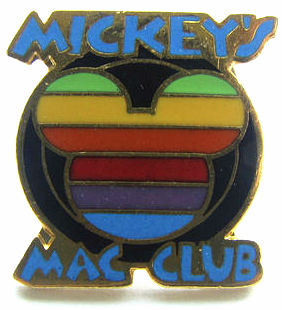
Disney Studio Macintosh Users Group "Mickey Mac Club" Pin (1991)
Sold
These rare "Mickey's Mac Club" enameled pins were produced to be given out to members of the Macintosh User's Group at employees of Disney Studios.
Unfortunately, Disney stepped in and would not allow the Mickey Mouse image or name to be associated with a commercial product including the Apple Macintosh.
The Macintosh users group was forced to use the name "The Mac Club" and to stop giving out the pins that had been produced.
The pins were designed by Bruce Gordon, creative director of Disney Imagineering.
Unfortunately, Disney stepped in and would not allow the Mickey Mouse image or name to be associated with a commercial product including the Apple Macintosh.
The Macintosh users group was forced to use the name "The Mac Club" and to stop giving out the pins that had been produced.
The pins were designed by Bruce Gordon, creative director of Disney Imagineering.
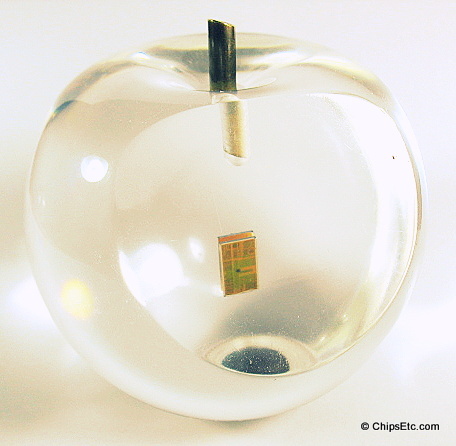
Apple Macintosh DOS Quadra 610 - Intel 486SX Processor Chip Paperweight (1993)
Item #952
This rare paperweight from Apple features two Intel 486 processor chips encased inside a Lucite version of Apple's famous logo - an apple with a bite out of it, complete with a stem made out of bronze.
This paperweight was made to celebrate Apple's first computer to feature an Intel processor inside - the Macintosh Quadra 610 DOS computer. Apple's revolutionary Quadra 610 "DOS compatible" computer was first introduced at Comdex on October 21st 1993 by Apple's CEO Michael Spindler.
It was a Quadra model 610 powered by a Motorola 68LC040 microprocessor with an additional Intel 486SX 25MHz processor integrated onto a "DOS compatibility" expansion card (codename "Houdini") that ran as a Co-Processor. The Intel 486SX Processor was a modified Intel 486DX processor without the floating point unit.
This DOS compatibility option hit the computer market in February 1994 and was available from Apple for $500 added to the base model Quadra 610's $1439 list price.
The standard Mac microprocessor and operating system would handle Mac system 7 programs, while an Intel Corp. 486 microprocessor would allow users to run Microsoft Corp.'s IBM-compatible DOS and Windows programs simultaneously.
This was the first time an Apple MAC computer was offered with an Intel processor inside. The hybrid Apple Quadra 610 was literally two computers in one — a Mac and a PC. It could run DOS, WINDOWS, and MAC software. DOS Compatibility was expected by Apple to be an inexpensive solution for MAC users needing to run PC software, but it failed in the marketplace because the DOS/PC emulation was under-powered and ran very slow (at Intel 286 processor speeds).
The Quadra 610 DOS computer was discontinued on July 18th 1994. The Apple Quadra 610 DOS compatible computer became the shortest-lived Macintosh model ever in Apple Computer history!
In November 1994, Apple would license the "DOS on MAC PC" expansion card thru a company called Reply Corporation, with inrcreased processing power via choices of either a Cyrix 50MHz 486DX2, or 66MHz 486DX2 CPU, with hopes by Apple that 486 chips would later be licensed from other manufactures including Intel, AMD and others.
Apple would not use Intel Processor chips in any of their computers again until 2006 with the introduction of their MacBook Pro and iMac Core Duo line. The transition to Intel processors was first announced at Apple's Worldwide Developers Conference in 2005 by Steve Jobs.
This paperweight was made to celebrate Apple's first computer to feature an Intel processor inside - the Macintosh Quadra 610 DOS computer. Apple's revolutionary Quadra 610 "DOS compatible" computer was first introduced at Comdex on October 21st 1993 by Apple's CEO Michael Spindler.
It was a Quadra model 610 powered by a Motorola 68LC040 microprocessor with an additional Intel 486SX 25MHz processor integrated onto a "DOS compatibility" expansion card (codename "Houdini") that ran as a Co-Processor. The Intel 486SX Processor was a modified Intel 486DX processor without the floating point unit.
This DOS compatibility option hit the computer market in February 1994 and was available from Apple for $500 added to the base model Quadra 610's $1439 list price.
The standard Mac microprocessor and operating system would handle Mac system 7 programs, while an Intel Corp. 486 microprocessor would allow users to run Microsoft Corp.'s IBM-compatible DOS and Windows programs simultaneously.
This was the first time an Apple MAC computer was offered with an Intel processor inside. The hybrid Apple Quadra 610 was literally two computers in one — a Mac and a PC. It could run DOS, WINDOWS, and MAC software. DOS Compatibility was expected by Apple to be an inexpensive solution for MAC users needing to run PC software, but it failed in the marketplace because the DOS/PC emulation was under-powered and ran very slow (at Intel 286 processor speeds).
The Quadra 610 DOS computer was discontinued on July 18th 1994. The Apple Quadra 610 DOS compatible computer became the shortest-lived Macintosh model ever in Apple Computer history!
In November 1994, Apple would license the "DOS on MAC PC" expansion card thru a company called Reply Corporation, with inrcreased processing power via choices of either a Cyrix 50MHz 486DX2, or 66MHz 486DX2 CPU, with hopes by Apple that 486 chips would later be licensed from other manufactures including Intel, AMD and others.
Apple would not use Intel Processor chips in any of their computers again until 2006 with the introduction of their MacBook Pro and iMac Core Duo line. The transition to Intel processors was first announced at Apple's Worldwide Developers Conference in 2005 by Steve Jobs.

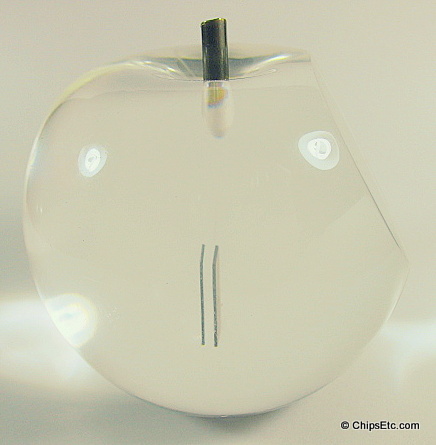
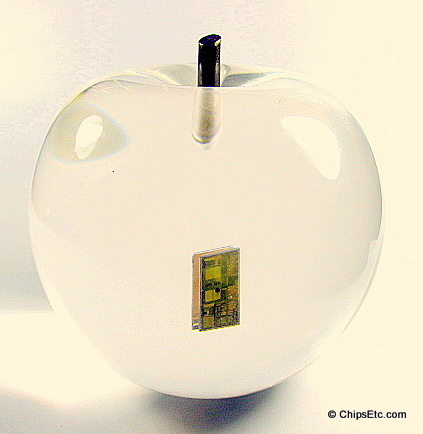
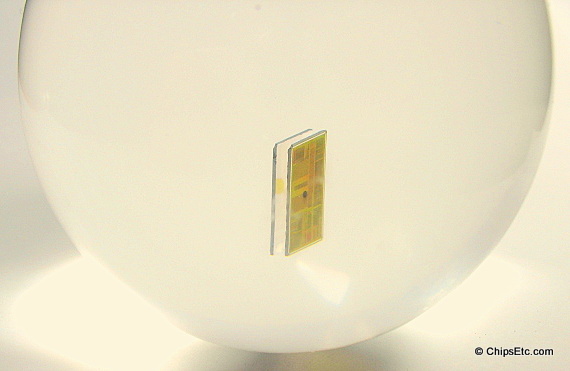
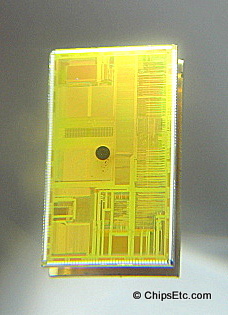
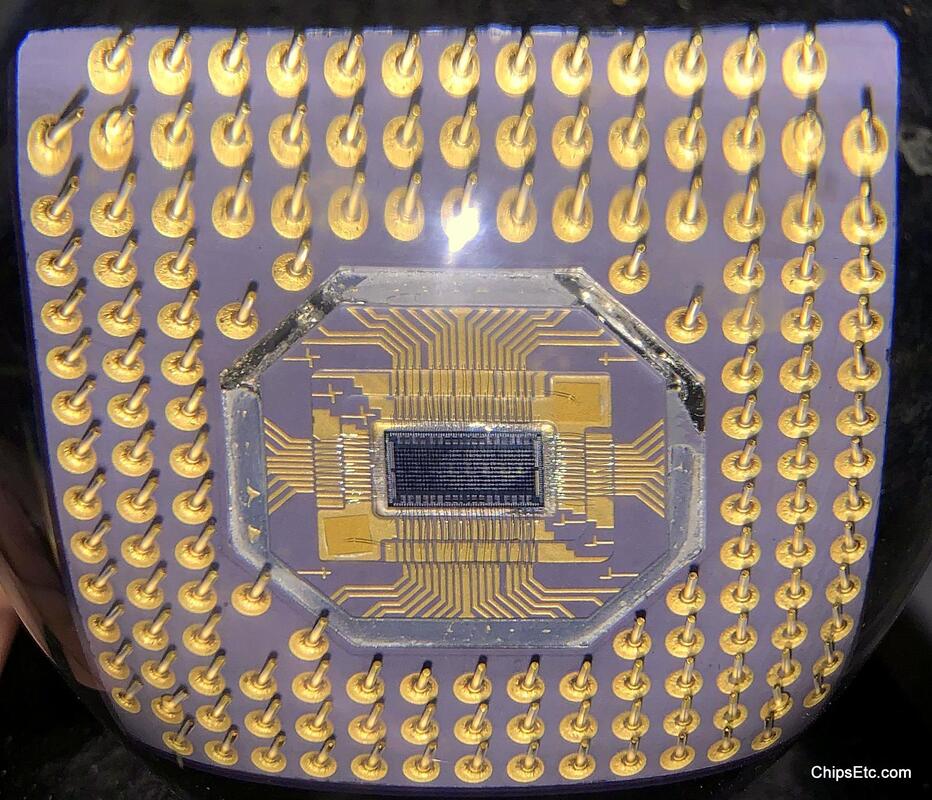
Apple Computer Paperweight with Processor Chip (1990s)
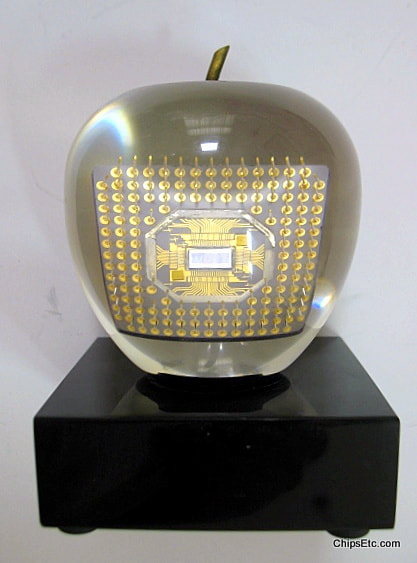
Item #999
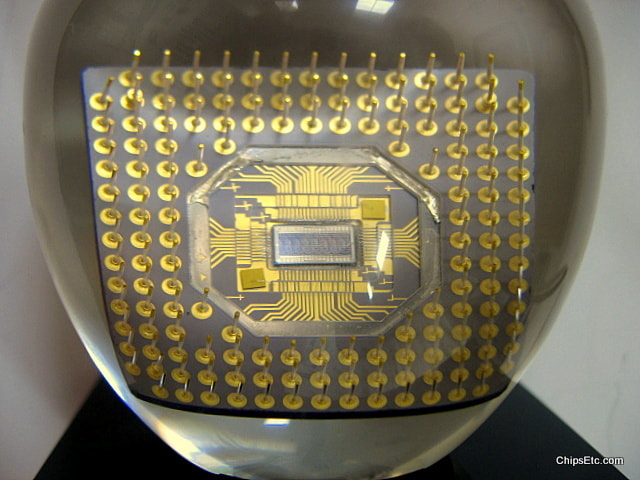
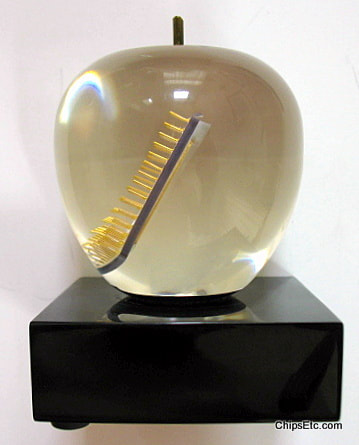
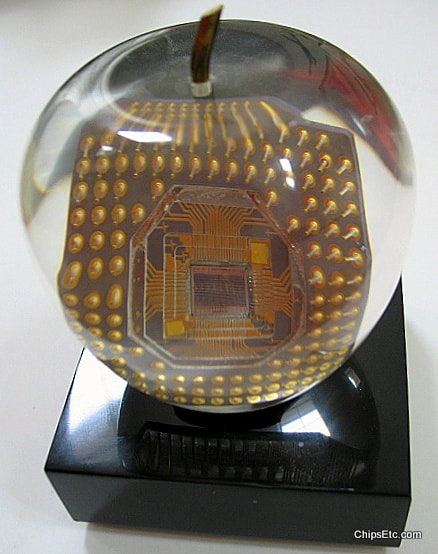
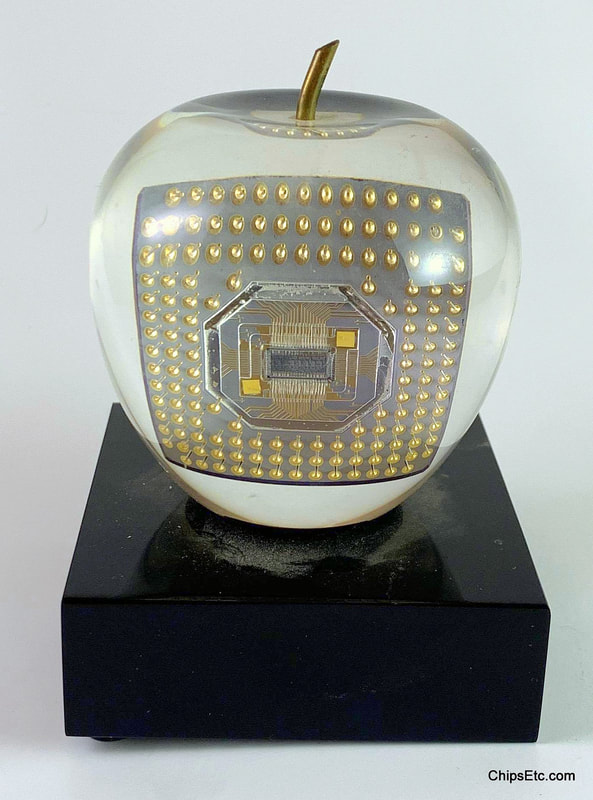
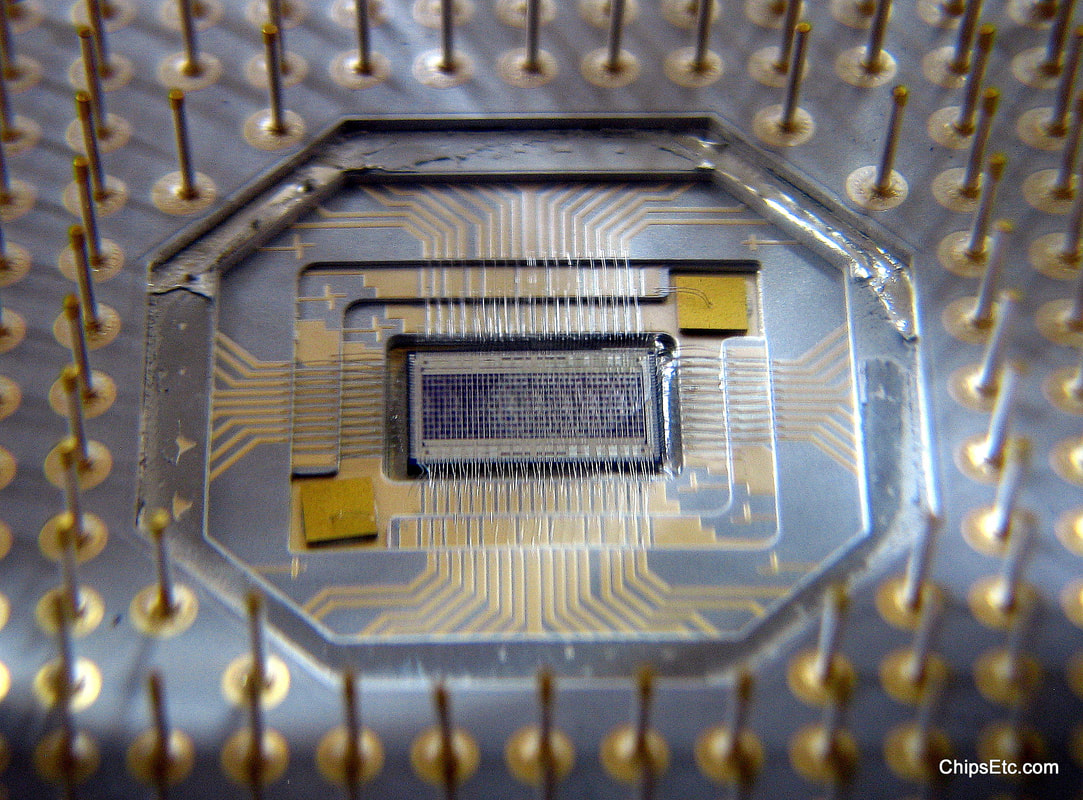
Another rare paperweight with an unknown processor chip embedded inside.
The processor is an unmarked, purple ceramic PGA package with it's underside lid removed so you can see the silicon die of the memory chip and it's gold wire bonding. It has a gold plated lid on the top side.
The clear apple paperweight with bronze stem sits on a black base.
The processor is an unmarked, purple ceramic PGA package with it's underside lid removed so you can see the silicon die of the memory chip and it's gold wire bonding. It has a gold plated lid on the top side.
The clear apple paperweight with bronze stem sits on a black base.

Apple / IBM PowerPC 601 Processor Chip Button (1994)
Sold
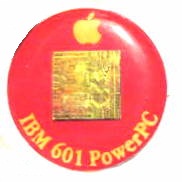
The IBM PowerPC 601 chip was the first version of a RISC processor developed jointly between IBM Microelectronics and Motorola. The PowerPC 601 was the first generation of microprocessors to support the basic 32-bit PowerPC instruction set. The 601 processor ran at speeds of 55-80Mhz. IBM was the sole manufacturer of the 601 microprocessors in its Burlington, Vermont and East Fishkill, New York production facilities. The 601 was manufactured using IBM's CMOS-4s process.
First launched in IBM systems in the fall of 1993, it was marketed by IBM as the PPC601 and by Motorola as the MPC601. It operated at speeds ranging from 50 to 80 MHz. It was fabricated using a 0.6 µm CMOS process with four levels of aluminum interconnect. The die was 121 mm² large and contained 2.8 million transistors.
The 601 has a 32 kB unified L1 cache, a capacity that was considered large at the time for an on-chip cache. Thanks partly to the large cache it was considered a high performance processor in its segment, outperforming the competing Intel Pentium processor.
The PowerPC 601 was used in the first Power Macintosh computers from Apple, and in a variety of RS/6000 workstations and SMP servers from IBM and Groupe Bull.
Stick-on promotional button has a real power PC chip encased inside enamel for viewing.
First launched in IBM systems in the fall of 1993, it was marketed by IBM as the PPC601 and by Motorola as the MPC601. It operated at speeds ranging from 50 to 80 MHz. It was fabricated using a 0.6 µm CMOS process with four levels of aluminum interconnect. The die was 121 mm² large and contained 2.8 million transistors.
The 601 has a 32 kB unified L1 cache, a capacity that was considered large at the time for an on-chip cache. Thanks partly to the large cache it was considered a high performance processor in its segment, outperforming the competing Intel Pentium processor.
The PowerPC 601 was used in the first Power Macintosh computers from Apple, and in a variety of RS/6000 workstations and SMP servers from IBM and Groupe Bull.
Stick-on promotional button has a real power PC chip encased inside enamel for viewing.
Apple / Motorola PowerPC 604 Chip Keychain (1995)
Sold
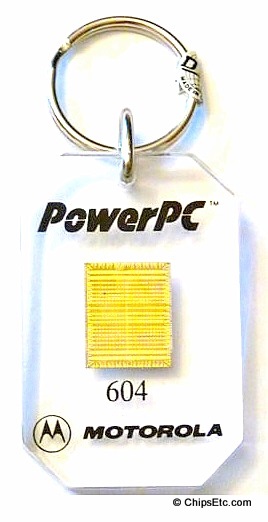
Motorola PowerPC Lucite keychain with a real Motorola 604 chip used in Apple Power PC line of computers.
Apple / Motorola PowerPC 604 CPU Chip Button (1995)
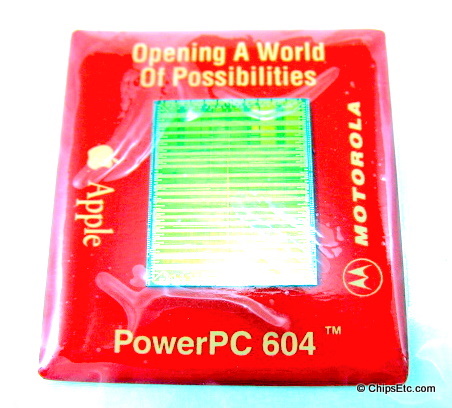
Item #080 (Item #201 & 208 similar)
The PowerPC 604 chip was a super-scalar RISC processor developed jointly between IBM Microelectronics and Motorola. These processors were targeted for general-purpose desktop computing and were used in the Apple Power Macintosh line of personal computers and in Mac clones. An AIM (Apple / IBM / Motorola) designed processor, the major design contributor was IBM. Apple contributed some of it's circuity design ingenuity and specifications, Motorola contributed it's vector engine (AltiVec, which Apple calls Velocity Engine). The processor was mostly a spin-off of IBM's multi-chip Power 4 architecture.
The PowerPC 604 was introduced in December 1994 alongside the 603 and was designed as a high-performance chip for workstations and entry-level servers and as such had support for symmetric multiprocessing in hardware.
The 604 was used extensively in Apple's high-end systems and was also used in Macintosh clones, IBM's low-end RS/6000d servers and workstations, Amiga accelerator boards, and as an embedded CPU for telecom applications.
In June 2005 Apple announced they would drop the PowerPC architecture and switch to Intel x86 Microprocessors, ending its longstanding relationship with IBM and Motorola. Apple CEO Steve Jobs attributed the switch to a superior Intel Microprocessor roadmap.
The 604 was a super-scalar processor capable of issuing four instructions simultaneously. The PowerPC 604 contained 3.6 million transistors and was fabricated by IBM and Motorola with a 0.5 µm CMOS process. The Silicon die measured 12.4 mm by 15.8 mm. It operated at speeds between 100 and 180 MHz.
This stick-on promotional button has a real PowerPC chip encased inside enamel for viewing. New and unused including adhesive backing. Measures 1" square.
The PowerPC 604 was introduced in December 1994 alongside the 603 and was designed as a high-performance chip for workstations and entry-level servers and as such had support for symmetric multiprocessing in hardware.
The 604 was used extensively in Apple's high-end systems and was also used in Macintosh clones, IBM's low-end RS/6000d servers and workstations, Amiga accelerator boards, and as an embedded CPU for telecom applications.
In June 2005 Apple announced they would drop the PowerPC architecture and switch to Intel x86 Microprocessors, ending its longstanding relationship with IBM and Motorola. Apple CEO Steve Jobs attributed the switch to a superior Intel Microprocessor roadmap.
The 604 was a super-scalar processor capable of issuing four instructions simultaneously. The PowerPC 604 contained 3.6 million transistors and was fabricated by IBM and Motorola with a 0.5 µm CMOS process. The Silicon die measured 12.4 mm by 15.8 mm. It operated at speeds between 100 and 180 MHz.
This stick-on promotional button has a real PowerPC chip encased inside enamel for viewing. New and unused including adhesive backing. Measures 1" square.
|
|
Apple Computer Mac OS Keychain (1984)
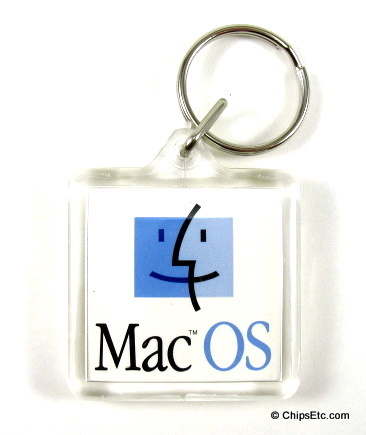
Item #046 (#192 & 193 similiar)
Apple introduced the Mac OS Operating System when it ushered in the mainstream GUI era with the 128K Mac Computer in 1984.
Acrylic keychain has the Mac OS logo on one side and the Apple logo on the other.
Acrylic keychain has the Mac OS logo on one side and the Apple logo on the other.
 Back of Apple Keychain |
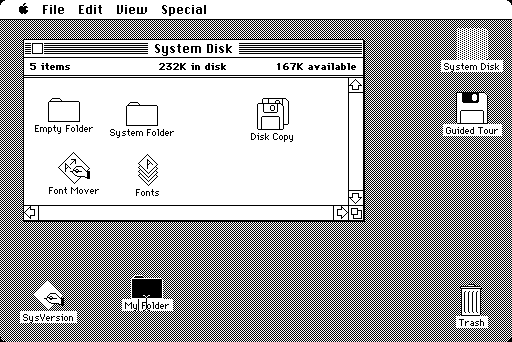 Screenshot of the Classic Mac OS desktop (1984) |
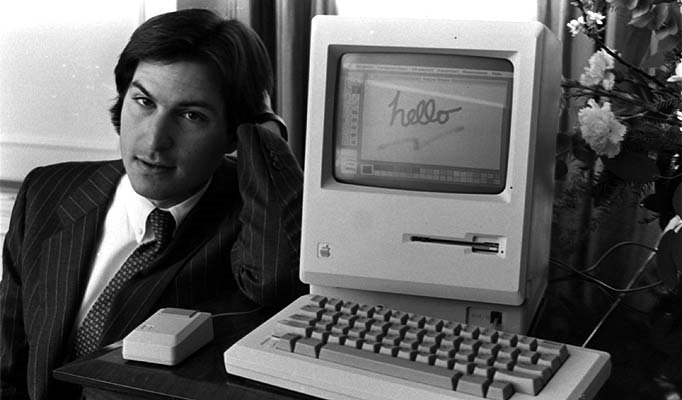
Steve Jobs with the Apple Macintosh computer (1984)
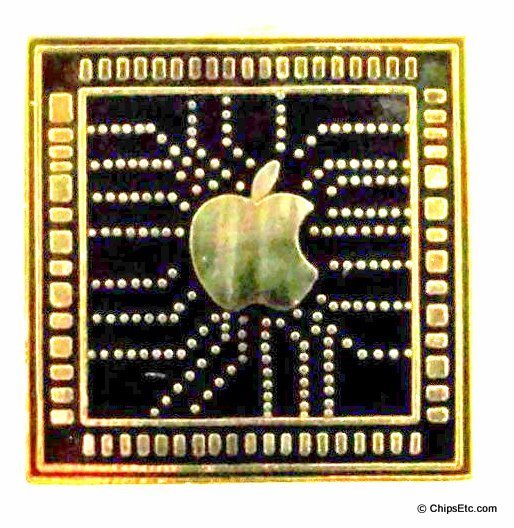
Apple Circuitry Logo Lapel Pin (1990's)
Sold
Brass plated Apple "circuity" design pin with black enamel.
VIDEO: Steve Jobs shows introduces the Apple Macintosh (1984)
Apple Macintosh - Performa - Quadra 630 Computer Pin (1994)

Item #062
The Apple Macintosh Model 630, introduced in 1994, replaced the Quadra 610 and was the last Quadra Macintosh computer model introduced by Apple. It was discontinued in 1995 with no replacement.
The MAC 630 had a Motorola 68040 or 68LC040 Running at 33 MHz and had 4 Mb of memory.
The MAC 630 had a Motorola 68040 or 68LC040 Running at 33 MHz and had 4 Mb of memory.
Apple logo Key Ring (1990s)

Sold
These keychains were provided as part of a promotion to Authorized Apple Retailers, as well as being used internally for gifts to Apple employees.
Measures 2" on each side & has three key loops.
Measures 2" on each side & has three key loops.
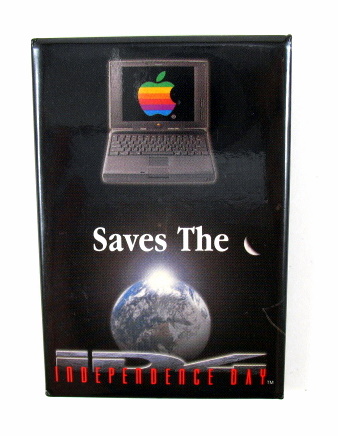
Apple PowerBook 5300 Independence Day Pin (1996)
Item #052 (#020 similar)
Released on July 2, 1996, "Independence Day" The movie tells the story of an unfriendly alien invasion, and the team of disparate individuals who must come together to save the world from destruction. Playing a central role in the film, a computer programmer played by Jeff Goldblum uses his Apple PowerBook 5300 laptop computer to help destroy the alien force and preserve mankind.
Apple retail employees wore the Apple Independence Day buttons during promotions starting beginning in June leading up to the movies release on July 2nd, the buttons carried the message of "save the world" with the Apple logo and a picture of an Apple PowerBook 5300 laptop.
Measures 2" x 3".
Apple retail employees wore the Apple Independence Day buttons during promotions starting beginning in June leading up to the movies release on July 2nd, the buttons carried the message of "save the world" with the Apple logo and a picture of an Apple PowerBook 5300 laptop.
Measures 2" x 3".
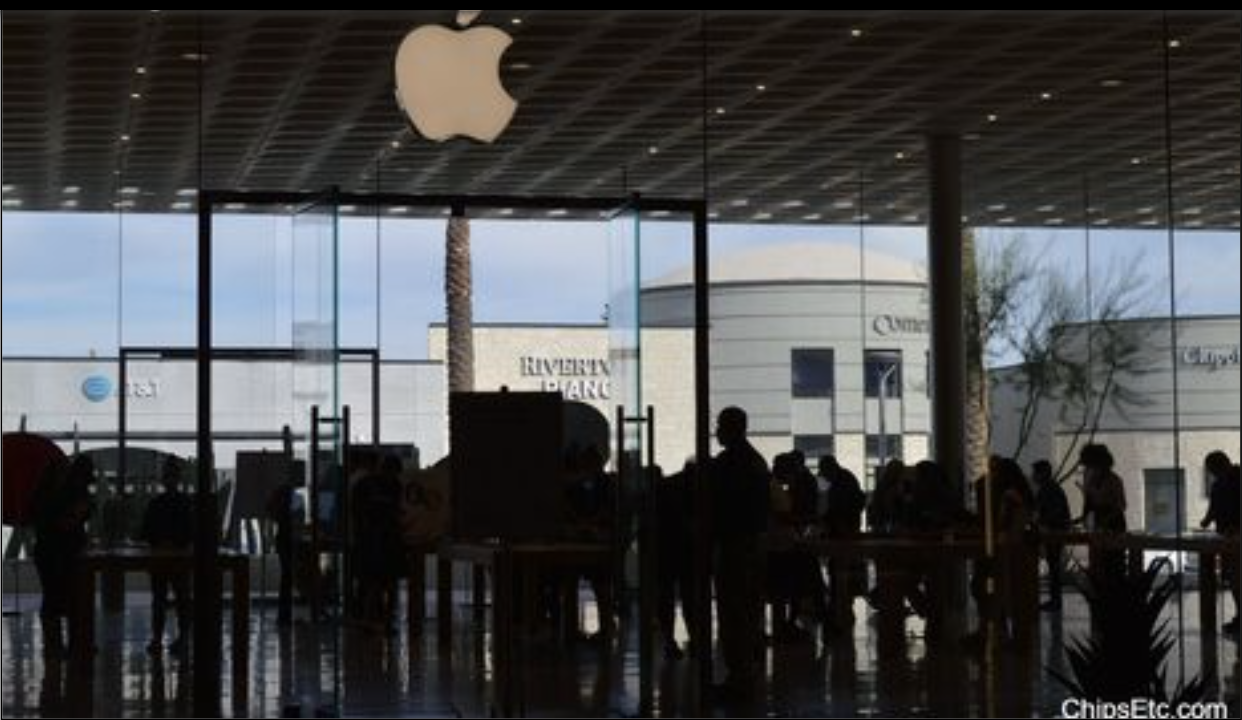
The Apple Store in Scottsdale, Az. (2021)